What is Personality?

Discover how millennia of human thought shaped our understanding of what makes each person unique

An individual's personality is formed from their unique combination of experiences, thoughts, interests, attitudes, and action tendencies. It is a systematic method of describing the shared components of individuality. Concepts of individuality and personality have developed over millennia through the work of artists, theologians, philosophers, medical professionals, and scientists across many different disciplines.

2,400+

Years of Study

5

Core Traits

Universal

Across Cultures

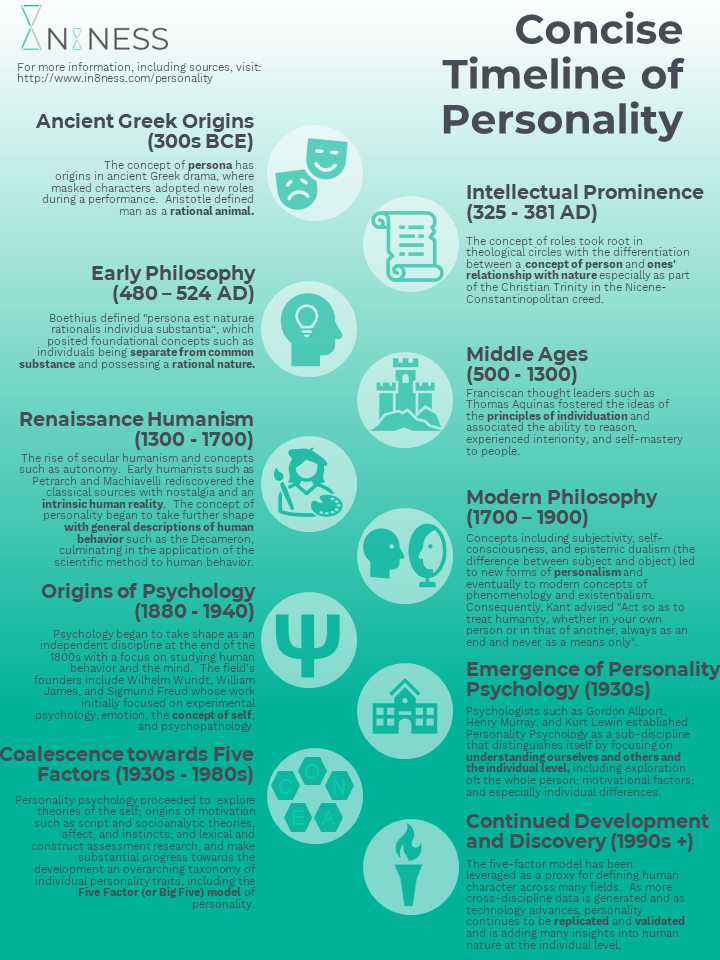
A Concise History of Personality

From ancient philosophy to modern psychology

Ancient & Classical Era

Ancient Greek Origins

300s BCE

The concept of persona has origins in ancient Greek drama, where masked characters adopted new roles during a performance (Williams & Bengtsson, 2022). Aristotle defined man as a rational animal.

Key Contributions: The Greek concept of character types, the four humors theory, and Aristotle's systematic study of human nature laid groundwork for modern personality psychology. The theatrical use of masks (personae) introduced the idea that individuals could embody different roles and characteristics.
Theological Intellectual Prominence

325 - 381 AD

The concept of roles took root in theological circles with the differentiation between a concept of person and ones' relationship with nature especially as part of the Christian Trinity in the Nicene-Constantinopolitan creed.

Key Contributions: Early Christian theology established the concept of personhood as distinct from nature, introducing philosophical frameworks for understanding individual identity within larger systems. This theological work influenced Western concepts of individuality and self.

Medieval Period

Early Philosophical Conceptions

480 - 524

Boethius defined "persona est naturae rationalis individua substantia", which posited foundational concepts such as individuals being separate from common substance and possessing a rational nature.

Middle Ages

500 - 1300

Franciscan thought leaders such as Thomas Aquinas fostered the ideas of the principles of individuation and associated the ability to reason, experienced interiority, and self-mastery to people.

Key Contributions: Medieval scholars developed sophisticated theories of individuation—what makes each person unique—and emphasized the role of reason and free will in shaping personality. These concepts remain foundational to modern personality theory.

Renaissance & Enlightenment

Renaissance Humanism

1300 - 1700

The rise of secular humanism and concepts such as autonomy. Early humanists such as Petrarch and Machiavelli rediscovered the classical sources with nostalgia and an intrinsic human reality (Grudin, 2017). The concept of personality began to take further shape with general descriptions of human behavior such as the Decameron, culminating in the application of the scientific method to human behavior.

Key Contributions: The Renaissance marked a shift toward empirical observation of human nature. Literary works began systematically cataloging human behaviors and motivations, while emerging scientific methods provided new frameworks for studying personality objectively.

Modern Philosophy

1700 - 1850

Concepts including subjectivity, self-consciousness, and epistemic dualism (the difference between subject and object) led to new forms of personalism and eventually to modern concepts of phenomenology and existentialism. Consequently, Kant advised "Act so as to treat humanity, whether in your own person or in that of another, always as an end and never as a means only".

Key Contributions: Enlightenment philosophers established the concept of the autonomous, rational self. This period introduced systematic introspection and the idea that personality could be understood through self-examination and philosophical inquiry, setting the stage for psychological science.

Modern Psychology

Origins of Psychology

1880 - 1940

Psychology began to take shape as an independent discipline at the end of the 1800s with a focus on studying human behavior and the mind. The field's founders include Wilhelm Wundt, William James, and Sigmund Freud whose work initially focused on experimental psychology, emotion, the concept of self, and psychopathology.

Key Contributions: The birth of psychology as a science brought rigorous experimental methods to the study of personality. Early psychologists established laboratories, developed measurement techniques, and began systematically testing theories about human nature and individual differences.

Emergence of Personality Psychology

1930s

Psychologists such as Gordon Allport, Henry Murray, and Kurt Lewin established Personality Psychology as a sub-discipline that distinguishes itself by focusing on understanding ourselves and others at the individual level, including exploration of: the whole person; motivational factors; and especially individual differences (McAdams, 1997).

Key Contributions: Personality psychology emerged as a distinct field focused on individual differences rather than universal principles. This marked a shift toward understanding what makes each person unique, laying the foundation for trait-based models and assessment instruments.

Coalescence towards Five Factors

1930s - 1980s

Personality psychology proceeded to explore theories of the self; origins of motivation such as script and socioanalytic theories, affect, and instincts; lexical and construct assessment research, and make substantial progress towards the development an overarching taxonomy of individual personality traits, including the Five Factor (or Big Five) model of personality.

Key Contributions: Decades of factor-analytic research across cultures and languages converged on five broad dimensions of personality. The Big Five model (Extraversion, Agreeableness, Conscientiousness, Neuroticism, Openness) became the most widely accepted framework for understanding personality structure.

Continued Development and Discovery

1990s +

The five factor model has been leveraged as a proxy for defining human character across many fields. As more cross-discipline data is generated and as technology advances, the scientific construct of personality continues to be replicated and validated and is adding many insights into human nature at the individual level (Roberts & Yoon, 2022).

Key Contributions: Modern personality research integrates neuroscience, genetics, developmental psychology, and big data analytics. Studies continue to reveal how personality influences health, relationships, career success, and well-being, while also exploring how personality develops and changes across the lifespan.

Visual Timeline

See the complete history of personality psychology at a glance

Explore Personality Further

The Five Factors

Discover the Big Five personality traits and what they mean

Learn More

Take an Assessment

Measure your own personality traits with our scientifically validated tools

Get Started

Research & Insights

Read the latest personality research and scientific findings

Browse Articles

References

1
Grudin, R. (2017). Humanism. Encyclopedia Britannica.
2
McAdams, D. P. (1997). A Conceptual History of Personality Psychology. In Hogan, R., Johnson, J., & Briggs, S. (Eds.), Handbook of Personality Psychology (pp. 3-39). San Diego, CA, US: Academic Press.
3
Roberts, B. W., & Yoon, H. J. (2022). Personality Psychology. Annual review of psychology, 73, 489–516.
4
Williams, Thomas D. and Jan Olof Bengtsson, 'Personalism', The Stanford Encyclopedia of Philosophy (Summer 2022 Edition), Edward N. Zalta (ed.)