1
Ozer, Daniel & Benet, Veronica. (2006). Personality and the Prediction of Consequential Outcomes. Annual Review of Psychology. 57. 401-21.
Discover how personality traits predict important outcomes across individual, interpersonal, and social-institutional domains
Over the last 100 years, there has been a growing body of academic research dedicated to understanding and working towards defining personality and how differences among personalities are related to important individual, interpersonal, and social-institutional outcome constructs that impact our lives in important ways (Ozer & Benet, 2006). Large-scale replication studies have reinforced confidence in these findings (Soto, 2019). Thus far, there are over 40 outcomes which have been found by peer-reviewed research to have a valid and reliable relationship with five factor personality traits. Outcomes can be associated with one or more of the five factor traits and the relationship can be positive or negative.
Years of Research
Validated Outcomes
Outcome Domains
See how personality traits connect to life outcomes
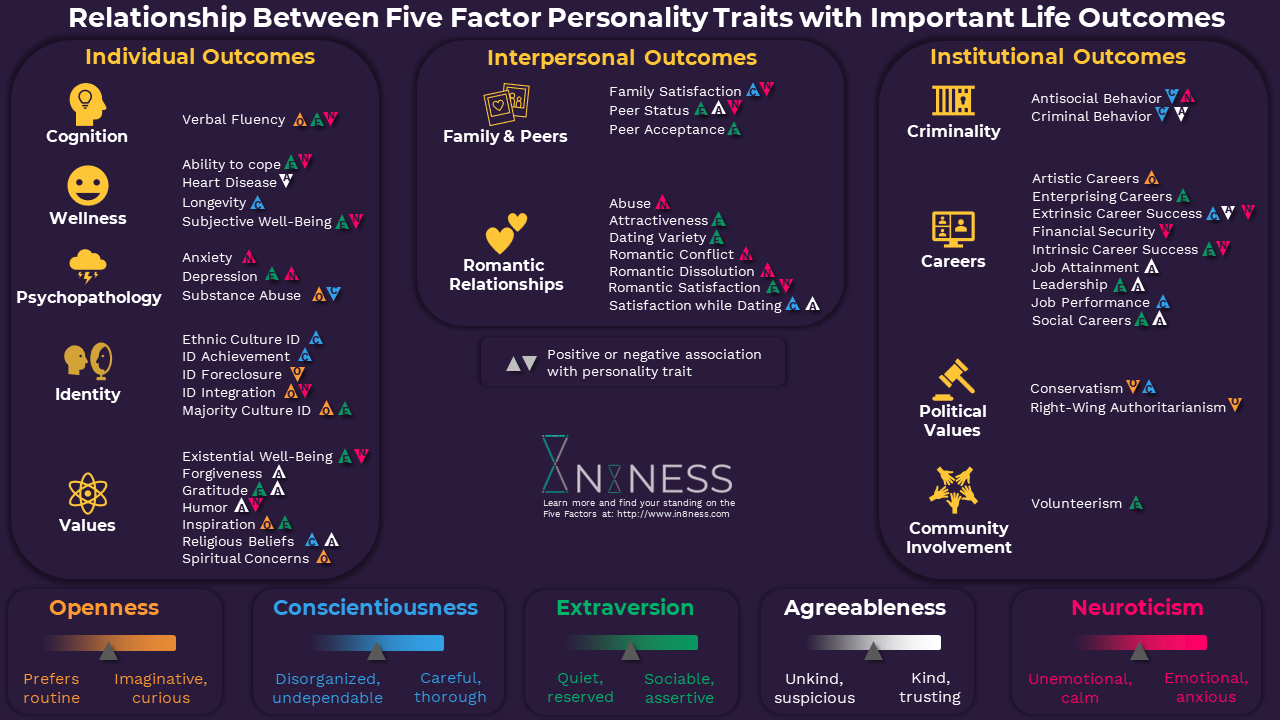
Individual level outcomes are those that mainly have an impact to ones' self. Related outcomes include cognitive ability, happiness, physical and mental health, self-identity, and personal values.
Mellow musical styles feature romantic, slow, and quiet attributes, typically found in genres like soft rock, R&B, and adult contemporary.
Unpretentious musical styles are defined by uncomplicated, relaxing, and unaggressive attributes, often heard in country genres.
Coping refers to the ability to overcome a stressful situation. Strategies that are commonly used to cope include: distraction, redefinition, direct action, catharsis, acceptance, social support, relaxation, and religion.
Physical activity level refers to the overall quantity of bodily movement produced by skeletal muscles that results in energy expenditure above resting levels, typically operationalized as frequency, duration, or volume of leisure-time exercise and structured physical activity across a given period.
Chronotype refers to an individual's biological preference for the timing of sleep and wakefulness. Morning types naturally prefer earlier sleep and wake times; evening types prefer later schedules. Assessed via MEQ (Morningness-Eveningness Questionnaire) or MCTQ (Munich Chronotype Questionnaire).
Sleep quality refers to the subjective experience and objective characteristics of sleep, including ease of onset, continuity (minimal awakenings), duration adequacy, and feeling rested upon waking. Commonly assessed with the Pittsburgh Sleep Quality Index (PSQI), a global score ≥5 indicating poor sleep quality.
A composite index combining multiple dietary components to reflect overall diet quality, typically subtracting unhealthy food consumption from healthy food consumption scores.
Dream vividness refers to the sensory richness, perceptual clarity, and lifelike quality of dream experiences: the extent to which dream imagery, sounds, emotions, and sense of presence are experienced as detailed and realistic. Assessed via retrospective self-report scales or prospective dream diary ratings.
Lucid dreaming frequency refers to how often an individual experiences lucid dreams - dreams in which the dreamer is aware, while dreaming, that they are in a dream state, sometimes accompanied by the ability to influence or direct the dream narrative. Assessed via retrospective rating scales or prospective dream diaries.
Type I Anxiety includes the following categories: generalized anxiety disorder, obsessive-compulsive disorder, panic disorder, post-traumatic stress disorder, and social phobia.
Coronary Heart Disease (CHD) or Coronary Artery Disease (CAD) is a significant health risk (causing illness and death) and generally occurs when blood vessels supplying the heart with blood become damaged from cholesterol buildup & inflammation.
Major depression is a mood disorder that causes a persistent feeling of sadness and loss of interest.
A persons identity refers to a self-structure: an internal, self-constructed, dynamic organization of drives, abilities, beliefs, and individual history (Marcia, 1980). Identity integration and consolidation are processes of reconciling various roles, responsibilities, and contexts to construct a coherent identity.
Spiritual concern refers to an individuals interest in the nature of social constructs labeled spiritual, religious, peak, mystical, transpersonal, transcendent, or numinous.
Subjective Well-Being is a construct that reflects an individuals overall evaluation on the quality or their life from their own perspective.
Cultural identification refers to an individuals sense of belonging to a certain cultural group (e.g., Canadian, American, or Chinese).
Intense musical styles are characterized by distorted, loud, and aggressive attributes, common in classic rock, punk, heavy metal, and power pop genres.
Inspiration refers to the process of being mentally stimulated to do something and may involve the following characteristics: transcendence (larger than normal concerns), evocation (unwilled), and motivation (desire to make manifest) (Thrash & Elliott, 2004).
Dream recall frequency refers to how often an individual is able to remember their dreams upon waking. Assessed via retrospective rating scales (e.g., 7-point scales from 'never' to 'almost every morning') or prospective dream diaries. It is considered the 'gateway' to all other dream research domains, as dreams can only be studied once remembered.
Nightmare frequency refers to how often an individual experiences nightmares; intensely negative dreams that typically awaken the sleeper and leave behind strong feelings of fear, distress, or lingering unease. Assessed via retrospective self-report rating scales (e.g., 8-point scales ranging from 'never' to 'several times a week').
According to Marcia (1980), identity foreclosure refers to individuals who have committed to a set of occupational and ideological positions (beliefs, attitudes, values), but arrived at these positions through inheritance from external influence [rather than internal reflection]
Sophisticated musical styles feature inspiring, complex, and dynamic attributes, prevalent in classical, operatic, avant-garde, and traditional jazz genres.
Cultural identification refers to an individuals sense of belonging to a certain cultural group (e.g., Canadian, American, or Chinese).
General intelligence (g): the common factor underlying performance across diverse cognitive ability tests, encompassing fluid reasoning, crystallized knowledge, verbal ability, and nonverbal problem-solving.
Substance abuse refers to use of drugs or alcohol to the extent that it interferes with normal social behavior.
According to Marcia (1980), identity achievement is the identity status aligned with people who have experienced a decision-making period and are pursuing self-chosen occupation and ideological goals (in contrast to identity status types of foreclosure, identity diffusion, and moratorium).
The tendency to transition ones responses toward a perceived transgression from negative into neutral or positive.
Existential Well-Being is a construct that reflects an individuals sense of meaning, purpose, and resilience.
Verbal fluency is the ability to produce correct examples from a specific category. It is a cognitive task that relies on verbal knowledge, inhibition of similar words from a different semantic category, and tracking / memory of words that have already been produced.
Risky behavior (e.g., substance abuse, hazardous driving, unprotected sex with multiple partners, attempted suicide) increases the likelihood of negative health outcomes. Longevity refers to the length of an individuals life.
Contemporary musical styles represent music with rhythmic, upbeat, and electronic attributes, found in genres such as rap, electronica, Latin, and Euro-pop.
The general tendency to appreciate amusement, comedy, jokes, self-referential humor, jests, wit, or sarcasm.
MacDonald (2000) defined Religious / Spiritual concerns as a five component construct, including: cognitive orientation (perceptions and attitudes toward religious experience); experiential (mystical, transcendental, and transpersonal experiences); existential well-being (a sense of meaning, purpose, and resilience regarding ones existence); and religiousness (religious practice).
Gratitude is a general tendency to recognize and respond with grateful emotion when experiencing positive outcomes that are attributable to the benevolence of others.
Interpersonal outcomes are those that impact the closest relationships of a person, such as with friends and family members.
Romantic abuse refers to physical acts of abuse between romantic partners (e.g., slapping, hitting, forcing sex, etc.).
Attractiveness is the quality of being appealing and arouse interest from others.
Autonomy support refers to parental behaviors that encourage children's independent exploration, self-expression, and goal formulation. Its conceptual opposite, coercion or psychological control, is characterized by intrusiveness, overprotection, and high power assertion.
Behavioral control (structure) refers to the degree to which parents set clear expectations, supervise, and use consistent and appropriate discipline. It encompasses limit-setting, monitoring, contingent responding to child behavior, and scaffolding of self-regulation.
Dating variety refers to the number of different people dated (going out on a social or romantic engagement with someone) over a period of time.
Family satisfaction in this context refers to quality of dyadic relationships between intergenerational family members (e.g., parent-child).
Peer acceptance refers to relationships within a peer group network where one peer positively acknowledges another (e.g., nominates another person as a friend).
Peer status refers to relationships within a peer group network using measures such as peer acceptance (one peer nominates another as a friend) and friendship (two peers nominate each other as friends). Status often refers to differences in prominence, respect, and influence among members of a group.
Peer status refers to relationships within a peer group network using measures such as peer acceptance (one peer nominates another as a friend) and friendship (two peers nominate each other as friends). Status often refers to differences in prominence, respect, and influence among members of a group.
Relationship quality is the overall health of a relationship, shaped by how well partners communicate, handle conflict, support each other, stay stable over time, and feel satisfied.
Romantic conflict refers to sources of disagreement between romantic partners.
The breakup of a romantic relationship (e.g., separation or divorce).
Romantic satisfaction refers to married partners evaluations of the romantic relationship.
Romantic satisfaction refers to dating partners evaluations of the romantic relationship.
Parental warmth refers to the degree to which parents intentionally foster individuality, self-regulation, and self-assertion by being attuned, supportive, and responsive to the child's emotional and developmental needs. It encompasses acceptance, affection, positive affect, and sensitivity in parent–child interactions.
Social-Institutional outcomes refer to an individual's impact to larger institutions and society in general. This includes criminal behavior, career outcomes, and citizenship.
In the context of a pandemic health crisis, sheltering in place refers to the act of adhering to publich health guidelines to stay at a primary residence, avoiding travel and other public settings as much as possible.
Antisocial behavior refers to actions that are deemed delinquent, deviant, against social norms, and violate the rights of others.
According to Hollands RIASEC model, artistic occupational interests which include activities involving literature, music, and art (Holland, 1996).
Conservatism is generally associated with the values of freedom [over equality], security, power, achievement, conformity, and tradition.
Criminal behavior indicates that someone has participated in an unlawful act (e.g., theft, vandalism, robbery, assault, public endangerment, etc.).
According to Hollands RIASEC model, Social occupational interests include persuading, manipulating, or directing others (Holland, 1996).
Extrinsic career success (e.g., salary and promotions) refer to observable rewards from the job.
Financial security refers to the degree that people perceive that their earnings are adequate for their needs.
Intrinsic success is measured in terms of an individuals job satisfaction regarding multiple facets of their career (e.g., income, supervision, job security, coworkers).
According to Hollands RIASEC model, Investigative occupational interests include activities involving exploration, understanding and prediction or control of natural and social phenomena (Holland, 1996).
Occupational attainment is a construct representing different levels of success according to an objective (e.g., low-level unskilled jobs or high-level highly skilled jobs).
Job satisfaction refers to a pleasurable or positive emotional state resulting from the appraisal of ones job / work experiences.
Leadership behavior involves inspiring the support of followers to cooperate and take action.
The psychological and emotional attachment an individual feels to an occupation.
Occupational performance refers to employee actions and behaviors that are relevant to an organizations goals and are measurable. Measures include proficiency such as performance ratings and productivity.
Right-wing authoritarianism encapsulates behavior that is submissive to authorities, authoritarian aggression, and conventionalism. It is thought that this behavior may manifest as aggression towards outgroups.
According to Hollands RIASEC model, Social occupational interests include helping, teaching, treating, counseling, or serving others through personal interaction (Holland, 1996).
Vaccine hesitancy and resistance refers to a situation where someone is unsure of or against vaccination.
Volunteerism involves planned prosocial behavior benefitting strangers.
Masking refers to the practice of wearing a face covering when in the presence of other people, as a method to prevent the spread of airborne diseases.
Select various trait levels and visualize the impact to life outcomes
Try Simulator"Indelible Implications of Individuality: Connections Between Personality Traits and Over 40 Important Life Outcomes"
Read Article